Skip to content

Understanding the La Liga Table: A Complete Overview
For football fans, the La Liga table is a dynamic snapshot of a season-long battle. Understanding how it works is crucial to fully appreciating the competition.
This guide will break down the intricacies, explaining how teams are ranked, what factors influence their position, and how to interpret the key statistics.
The Basics: Points, Wins, and Goal Difference
At its core, the La Liga table is based on a simple points system:
- 3 points for a win
- 1 point for a draw
- 0 points for a loss
These points accumulate over the 38-game season. The team with the most points at the end of the season is the champion. Tie-breakers come into play when teams have the same number of points.
The primary tie-breaker is the head-to-head record. Goal difference is only considered if the head-to-head record is also tied. Goal difference is calculated by subtracting the number of goals conceded from the number of goals scored. If goal difference is also identical, then the total number of goals scored is considered. Only as a final resort is a play-off considered, though this is exceptionally rare.
Decoding the Columns: What the Stats Tell You
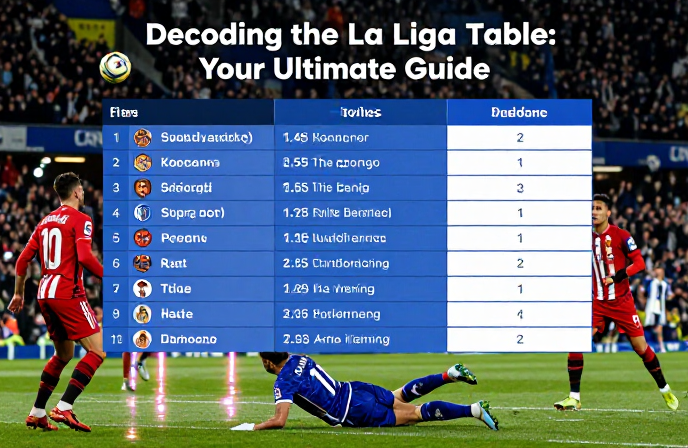
The La Liga table presents a wealth of information beyond just points. Each column provides valuable insights into a team’s performance.
- Pos: Team’s current position.
- Team: The name of the football club.
- P: Number of matches played.
- W: Number of matches won.
- D: Number of matches drawn.
- L: Number of matches lost.
- GF: Goals For (goals scored).
- GA: Goals Against (goals conceded).
- GD: Goal Difference (GF minus GA).
- Pts: Total points accumulated.
Analysing these columns can reveal interesting trends. For example, a team with a high number of wins (W) and a positive Goal Difference (GD) is likely to be performing well.
The Title Race and European Qualification
The ultimate goal for most teams is to secure a spot in European competitions. The top four teams in the La Liga table qualify for the Champions League. The fifth and sixth placed teams usually qualify for the Europa League.
The battle for these coveted spots is often intense. Keeping a close eye on the La Liga table is essential to track the progress of your favourite team.
Relegation Battle: Avoiding the Drop
At the other end of the La Liga table, the stakes are just as high. The bottom three teams at the end of the season are relegated to the Segunda División (the second tier of Spanish football). Relegation can have significant consequences for a club.
Teams battling relegation often adopt a more defensive approach. Every match becomes a must-win.
Impact of Key Matches
Certain matches throughout the season can have a significant impact on the La Liga table. El Clásico, the match between Real Madrid and Barcelona, is one of the most highly anticipated matches. A win can provide a huge boost to a team’s morale.
Other key matches include derbies (local rivalries) and matches between teams vying for European qualification or battling relegation.
The Influence of Form and Momentum
A team’s recent form can have a significant impact on their position in the La Liga table. A team on a winning streak will climb the table quickly. Momentum is a powerful force.
Factors such as injuries, suspensions, and changes in management can all affect a team’s form and momentum.
La Liga Table: More Than Just Rankings
The La Liga table is a living document, constantly evolving. Following the La Liga table provides a comprehensive overview of team performance. The La Liga table evolves dynamically with each match, reflecting the ever-changing fortunes of its competing teams.
The drama of the La Liga table isn’t just about who’s on top. Every point matters. Regularly checking the La Liga table helps fans stay informed.
Analyzing Trends
Observing the La Liga table over several seasons reveals certain trends. Analysing these trends can provide valuable insights into the long-term dynamics of Spanish football. The La Liga table reflects not only current form but also the historical context of the league.
The beauty of the La Liga table lies in its simplicity and its complexity. Staying updated with the La Liga table is essential for any football enthusiast.
FAQ
What happens if teams are tied on points?
The first tie-breaker is the head-to-head record. If that’s also tied, goal difference is considered.
How many teams qualify for the Champions League?
The top four teams qualify for the Champions League.
How many teams are relegated each season?
The bottom three teams are relegated to the Segunda División.